
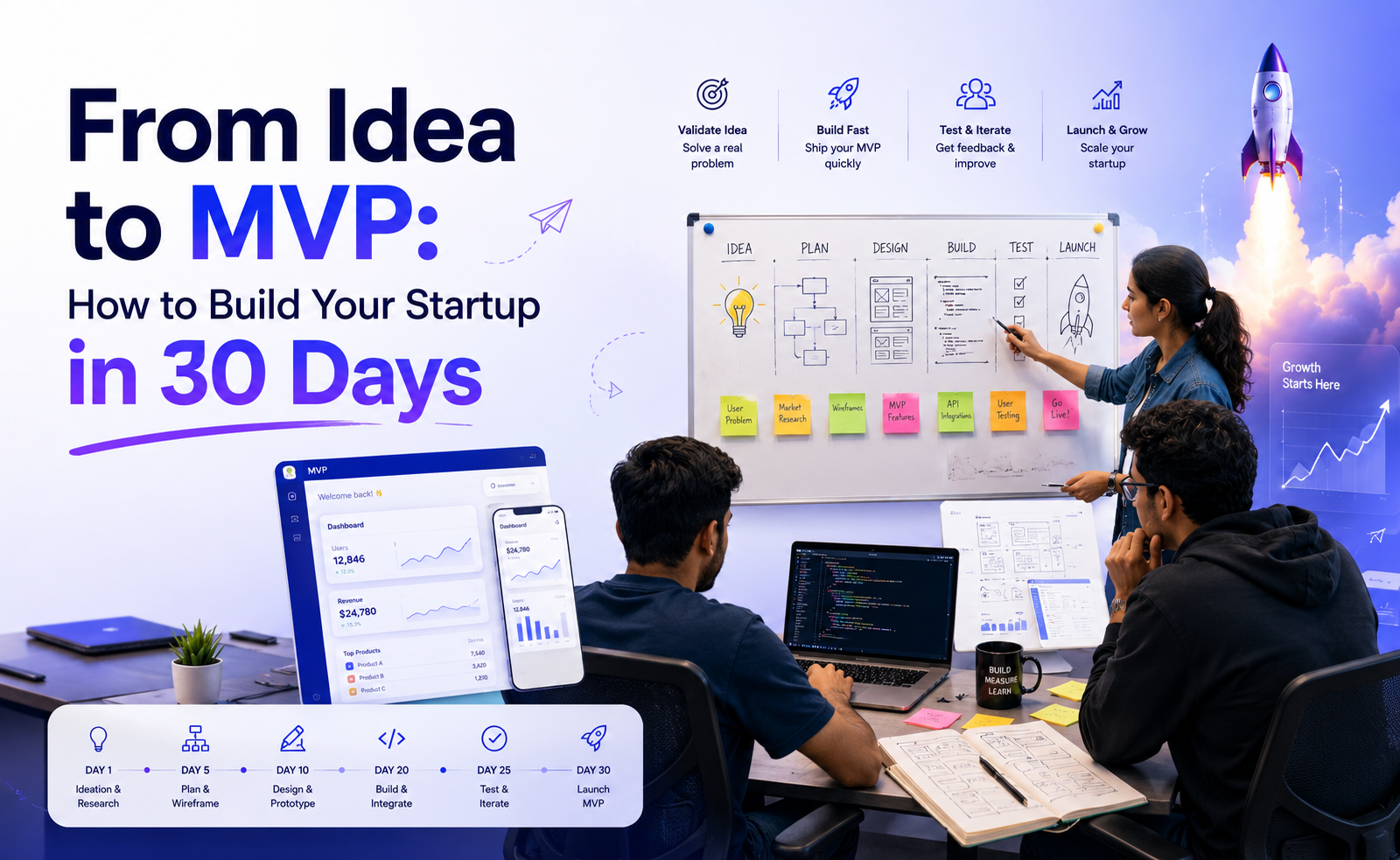
From Idea to MVP: How to Build Your Startup in 30 Days
A real, week-by-week breakdown of how to go from a raw idea to a working MVP that real people can use — not a pitch deck, not a business plan, but a real product in 30 days.
By a founder who's been in the trenches — and survived.
Let me be honest with you for a second.
Most "build your startup in 30 days" articles are written by people who've never actually done it. They're full of advice like "validate your idea!" and "find product-market fit!" — as if that means anything when you're sitting alone at 11 PM, staring at a half-written landing page and wondering if any of this is even worth it.
This isn't that article.
What I'm sharing here is a real, week-by-week breakdown of how you can go from a raw idea — just a seed of a thought — to a working MVP (Minimum Viable Product) that real people can actually use. Not a pitch deck. Not a business plan. A real product, in your hands, in 30 days.
It won't be perfect. It'll probably be a little embarrassing. But it'll exist. And "existing" beats "perfect" every single time when you're starting out.
Let's get into it.
First, Let's Kill the Myth
There's this romantic idea that startups are born in a flash of genius — that Zuckerberg woke up one morning with the full vision of Facebook crystal clear in his head. That's not how it works. Not for him, and certainly not for you and me.
Most great products started as something kind of ugly and unclear. Twitter was a side project. Airbnb was two guys renting air mattresses in their apartment. Slack was a video game company's internal chat tool.
The common thread? They shipped something. They stopped thinking and started building.
An MVP isn't your final product — it's the smallest, scrappiest version of your idea that lets you test whether the core thing you're offering actually matters to someone. If it does, great — you build more. If it doesn't, you learn that fast and pivot, instead of spending six months building something nobody wants.
Thirty days is enough to do that. Here's how.
Week 1 (Days 1–7): Sharpen the Idea Until It Cuts
Day 1–2: Get brutally specific about the problem
Here's the thing about most startup ideas — they're too vague. "I want to build an app that helps people be more productive." Okay, but which people? More productive how? When? Why aren't existing tools working for them?
Vague ideas build vague products. And vague products attract zero users.
Your first job is to pick one specific person with one specific problem and go deep on it. Not broad — deep.
Ask yourself:
- Who exactly is suffering from this problem right now?
- What are they currently doing to solve it (even if it's imperfect)?
- Why does the current solution fall short?
- How much does this problem actually cost them — in time, money, or stress?
Write it out in one sentence. If you can't describe the problem in a single sentence that a 12-year-old could understand, you haven't found the problem yet — you've found a category.
Bad: "People struggle with task management." Good: "Freelance designers lose 3–4 hours a week chasing clients for project feedback because email threads become impossible to track."
That second one? You can build something for that.
Day 3–4: Talk to real humans (yes, actual conversations)
Before you write a single line of code or design a single screen, go talk to five people who could be your ideal customer. Not your mom. Not your best friend who always says your ideas are great. Actual strangers or acquaintances who deal with this problem.
Call them. Message them on LinkedIn. Send cold emails. Offer a 20-minute coffee chat.
In those conversations, don't pitch your solution. Just listen. Ask them to walk you through their day, the specific moments the problem shows up, what they've tried, what frustrated them. You're not selling yet — you're learning.
This step feels awkward. People skip it because it feels uncomfortable to put yourself out there before you have something to show. But those five conversations will teach you more than five weeks of solo building. I promise you this.
Write down patterns. What words did multiple people use? What surprised you? What assumption you had turned out to be wrong?
Day 5–7: Define your MVP's single core promise
Now, armed with what you actually learned (not what you assumed), define your MVP in its smallest possible form.
The key word is minimum. Not minimum effort — minimum scope.
Ask yourself: "If my product could only do one thing, what would that one thing be — and would someone pay for it?"
Write a simple one-paragraph description of your MVP:
- What does it do?
- Who is it for?
- What's the one outcome it delivers?
Then cut it in half. Whatever you wrote — it's still probably too much. The tendency is always to build more than you need. Resist it. Your MVP is not your product roadmap. It's your first test.
Week 2 (Days 8–14): Design Before You Build
Day 8–9: Sketch the user journey on paper
Before you open Figma, before you write a line of code — get a notebook and draw the experience. Literally sketch it out with a pen.
What does the user do first when they arrive? What do they see? What do they click? Where do they end up? What's the "aha" moment — the moment they understand the value?
Keep it simple. Boxes and arrows are fine. You're not designing for beauty right now; you're designing for logic. Does the flow make sense? Does someone unfamiliar with your idea understand what to do without you explaining it?
If you need to explain your product to someone before they can use it, your design isn't done yet.
Day 10–12: Build a clickable prototype
Tools like Figma, Framer, or even a simple tool like Canva can let you build a prototype that looks and feels like a real product — without writing any code.
Create 5–8 screens that walk through the core user journey. Make buttons clickable. Link the screens together. Make it feel real enough that someone can sit down and "use" it without you guiding them.
Then — and this is the most important part — watch someone use it. Give it to one of the people you interviewed earlier. Don't explain anything. Just say "try to [core task]" and observe. Where do they hesitate? Where do they click the wrong thing? Where do they look confused?
Take notes. Go fix those things. This iteration loop — watch, learn, fix — is the most valuable thing you'll do this month.
Day 13–14: Make technology decisions
Now you can finally think about how to build it. This order is intentional — too many founders make tech decisions before they've validated the design, and end up building the wrong thing really well.
A few honest guidelines:
- Use what you know. This is not the time to learn a new language or framework. If you know Python, build in Python. If you know JavaScript, use that. The goal is speed, not technical elegance.
- Lean on existing tools. Stripe for payments. Firebase or Supabase for your database. Auth0 for authentication. Vercel or Railway for hosting. These aren't shortcuts — they're survival tactics for a 30-day build.
- No-code is legitimate. If you're non-technical, Bubble, Webflow, Glide, or Softr can get you to a working MVP faster than learning to code. Don't let anyone make you feel bad about that. Results are what matter.
The goal is to have a clear technical plan by end of Day 14, not a working product. You should know exactly what you're building and how.
Week 3 (Days 15–22): Build the Thing
This is where most people either shine or unravel. Building is exciting at first — then it gets hard, then it gets boring, then something breaks and it gets frustrating. This is normal. Push through it.
Day 15–19: Core functionality only
Build only what your MVP description said you would build. Every time you're tempted to add a feature — a nice-to-have, a "it would only take an hour" — write it down in a backlog document and leave it there.
The backlog is a graveyard of good ideas that would've killed your deadline. You'll revisit them later. Right now, they don't exist.
Be ruthless. A working login screen with no dashboard is better than a beautiful dashboard with a broken login.
At the end of each day, write down: What did I build? What's left? What's blocking me? It's simple, but this daily habit keeps you honest and stops you from waking up on Day 22 realizing you've built 60% of everything instead of 100% of something.
Day 20–22: Polish the edges (just enough)
This doesn't mean make it beautiful — it means make it not embarrassing. Fix broken layouts. Make error messages human-readable. Make sure the product works on mobile (if relevant). Add a simple loading state. Write copy that actually sounds like a person wrote it, not a robot.
The bar here is: would you be willing to send this link to someone you admire and ask them to try it? If the answer is yes, you're done with this phase. If it's "not quite yet," spend these three days getting there.
Week 4 (Days 23–30): Get It in Front of Real People
Day 23–25: Set up your launch infrastructure
Before you send anyone to your product, make sure the basics are in place:
- A simple landing page that explains what your product does in plain English (you should be able to read it aloud without cringing)
- A way to capture email addresses of people who sign up
- Basic analytics — even just Google Analytics or Plausible — so you know whether people are actually using what they signed up for
- A feedback channel — a simple typeform, a WhatsApp group, a "reply to this email" — somewhere people can tell you what's broken or confusing
This doesn't need to be fancy. It needs to work.
Day 26–28: Launch to a small, real audience
Notice I didn't say "launch to everyone." Your first launch isn't a product launch — it's a learning exercise disguised as a product launch.
Start with the people you interviewed in Week 1. Message them personally. Tell them you built something based on what they shared with you, and you'd love their honest feedback. That personal touch gets a response rate ten times higher than blasting a newsletter.
Then expand slightly — post in one community where your target users hang out. A Reddit thread, a Slack group, a Discord server, a LinkedIn post. One place. Not everywhere at once.
Watch what happens. Who signs up? What do they do after they sign up? Where do they stop? What questions do they ask? What do they complain about?
Day 29–30: Process feedback, not panic
At this stage, you will receive feedback that feels like a punch in the gut. Something you thought was obvious won't be. Something you spent three days building won't get used at all. Someone will say your product solves a problem they don't actually have.
This is not failure. This is the entire point.
Separate feedback into two buckets:
- Signal: Multiple people are stuck at the same place, confused by the same thing, or asking for the same feature.
- Noise: One person has a very specific opinion that doesn't reflect anyone else's experience.
Act on signal. Note noise. Don't try to please everyone — you'll end up pleasing no one.
By Day 30, you should have a clear picture of: does this thing I built match the problem I set out to solve? Are real people finding it useful? And most importantly — do I want to keep building this?
The Thing Nobody Tells You
Building an MVP in 30 days isn't really about the product. It's about you.
It forces you to make decisions with incomplete information — which is exactly what being a founder is. It forces you to talk to strangers, handle criticism, and keep going when things break. It shows you whether you actually want to build a startup, or whether you just like the idea of building one.
Both answers are valid. But you only find out by doing.
The people who build great companies aren't the ones with the best ideas. They're the ones who ship when it's messy, who listen more than they talk, and who treat every "this doesn't work" as a question to answer rather than a verdict on their worth.
You have 30 days. You have everything you need.
Start today.
The 30-Day Cheat Sheet
| Week | Focus | Key Output |
|---|---|---|
| Week 1 (Days 1–7) | Understand the problem | 5 customer interviews + 1-sentence MVP definition |
| Week 2 (Days 8–14) | Design the solution | Clickable prototype + tech decisions made |
| Week 3 (Days 15–22) | Build the core product | Working MVP with core functionality |
| Week 4 (Days 23–30) | Launch + learn | Real users, real feedback, next steps clear |
Have you built (or tried to build) an MVP? What was the hardest part? Drop your experience in the comments — I read every single one.